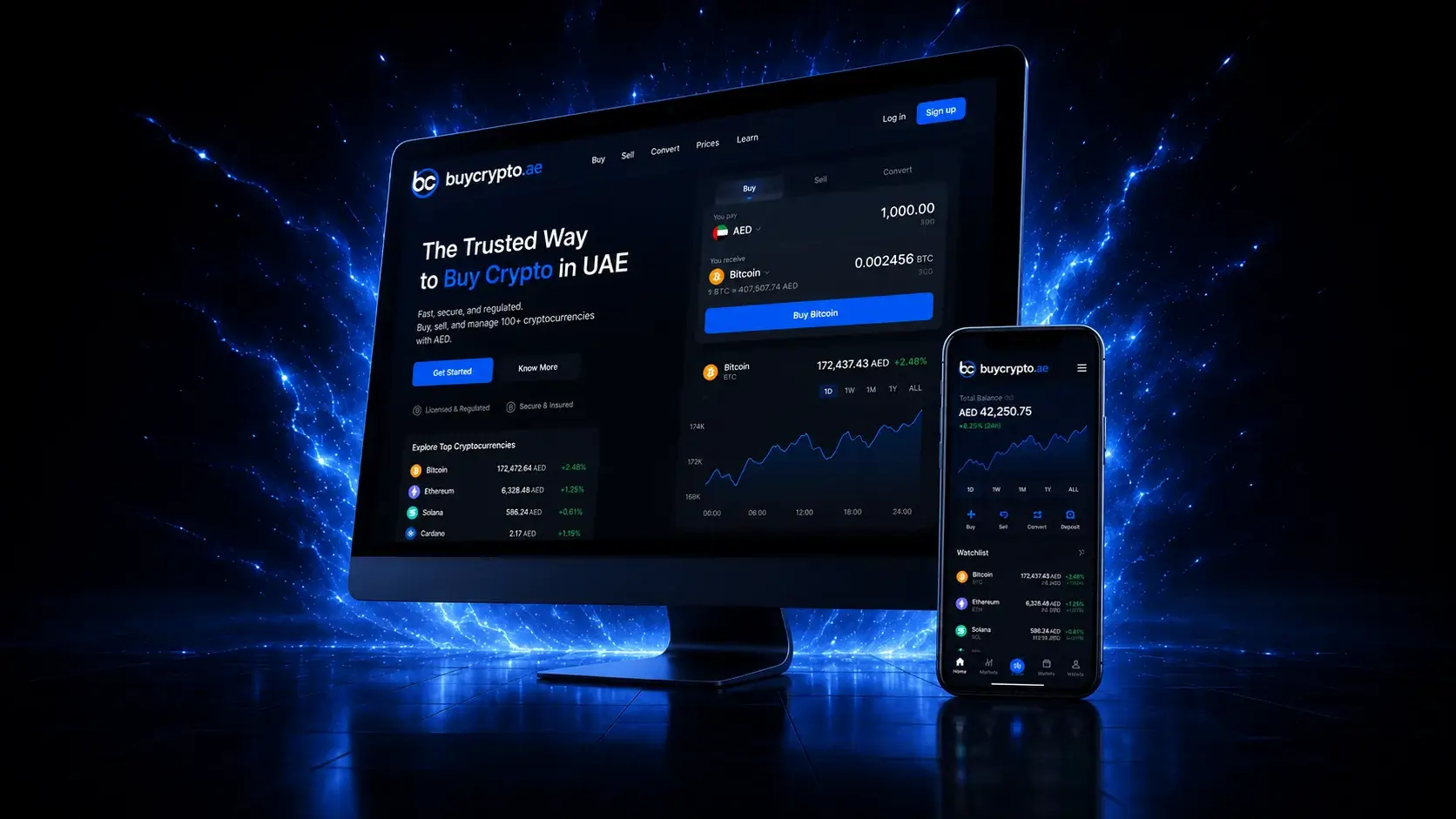
Buy crypto in the UAE the smart way. Compare VARA and FSRA-licensed exchanges, track live Bitcoin, Ethereum and USDT prices in dirhams (AED), and follow step-by-step buying guides for UAE residents. Independent and updated for 2026.
Trending coins with 7-day sparklines
Top 30 coins, updated every 60s
| # | Name | Price | 24h | Market Cap | |
|---|---|---|---|---|---|
| Loading... | |||||
Sign up with a VARA or FSRA licensed exchange that accepts dirhams.
Upload your Emirates ID or passport. Takes minutes.
Bank transfer for the lowest cost, or card for instant buys.
Place your order, then move coins to a wallet you control.

The most liquid exchange globally, with low fees and AED bank transfers.
Read reviewBuying crypto in the UAE has become one of the simplest financial tasks a resident can complete. The country runs a clear, licensed framework, several regulated exchanges accept dirham deposits, and verifying an account with an Emirates ID usually takes minutes rather than days. This guide explains how to buy crypto in the UAE step by step, what each method actually costs, how the law treats digital assets, and how to keep what you buy safe.
Whether you want to buy Bitcoin in Dubai, hold a long-term position in Ethereum, or simply move some savings into a dirham-pegged stablecoin, the mechanics are the same: open an account on a regulated platform, pass identity checks, fund the account in AED, and place your first order. The sections below walk through each stage and answer the questions most first-time buyers in the Emirates ask before they start.
Yes. Owning, buying, and selling cryptocurrency is legal for individuals across the United Arab Emirates, and the country has built one of the most developed regulatory frameworks in the world. What makes the UAE unusual is that oversight is split across several authorities, each covering a different jurisdiction, so the right answer to "is this platform allowed to serve me" depends on where you are and who licenses the exchange.
The Virtual Assets Regulatory Authority supervises virtual asset activity in the Emirate of Dubai, outside the Dubai International Financial Centre. VARA was the first regulator in the world created specifically for crypto, and its current rulebook sets detailed standards for exchanges, custodians, brokers, advisers, and token issuers. A VARA licence is widely treated as a mark of seriousness in the region.
The Financial Services Regulatory Authority oversees virtual assets inside the ADGM free zone in Abu Dhabi. ADGM was among the earliest jurisdictions anywhere to publish a full crypto framework, and it leans toward institutional custody, brokerage, and exchange operations under a common-law system.
Inside the DIFC, the Dubai Financial Services Authority runs its own crypto-token regime governing how recognised tokens can be issued, traded, and held. It is a separate jurisdiction from VARA even though both sit in Dubai.
At the federal level, the Securities and Commodities Authority sets nationwide policy for virtual assets used as investments, and the Central Bank of the UAE oversees payment tokens and stablecoins. Federal Decree-Law No. 6 of 2025 tightened the rules further, giving firms that serve UAE users a transition period running to September 2026 to become properly licensed or stop targeting the market. For an individual buyer this background matters in one practical way: it pushes activity toward licensed venues and away from grey-market operators.
For a deeper breakdown of how these bodies interact and what the 2026 changes mean, our crypto legality guide covers each regulator and the tax position in detail. The takeaway for most readers is simple: buying crypto for yourself is fully legal, and the safest route is a platform licensed by the authority that covers your Emirate.
The process to buy Bitcoin in the UAE, or any major cryptocurrency, follows the same five stages on every regulated exchange. Once you have done it once, repeat purchases take under a minute.
Pick a platform that holds the right licence for your Emirate and supports AED deposits. Register with your email, set a strong unique password, and turn on two-factor authentication immediately using an authenticator app rather than SMS where possible. If you are still deciding between providers, you can compare regulated UAE exchanges side by side before committing.
Every licensed exchange in the UAE requires identity verification. You will upload your Emirates ID or passport and complete a short selfie or liveness check. Verification is usually approved within a few minutes, occasionally up to a day during busy periods. KYC is not an inconvenience to avoid; it is the thing that lets a regulated platform legally hold your money and return it to you. Platforms advertising "no checks" sit outside the licensed framework and carry real risk, which we cover further down.
Add dirhams using the method that suits you. A local bank transfer from Emirates NBD, FAB, ADCB, Mashreq, or RAKBANK is normally the cheapest way in. Cards are faster but cost more. Peer-to-peer funding, where you buy a stablecoin directly from another verified user, is a popular route for keeping costs low. We break the trade-offs down in the funding section below.
Search for the asset, for example BTC, enter the amount in AED, and choose between a market order, which fills immediately at the current price, and a limit order, which only fills at a price you set. Beginners usually start with a small market order to see the full flow. You do not need to buy a whole coin; Bitcoin divides to eight decimal places, so a purchase of a few hundred dirhams is completely normal.
Your coins now sit in the exchange wallet. For small amounts that you trade often, that is usually fine. For larger or longer-term holdings, moving funds to your own self-custody wallet removes platform risk entirely. More on storage below.
How you pay shapes how much you pay. The four common routes for UAE residents each suit a different priority: cost, speed, or convenience.
A local transfer in dirhams is the lowest-cost on-ramp for most people. Deposits are commonly free, and you then buy on the spot market at the exchange's standard trading fee, which on major venues is often around a fraction of a percent. The trade-off is timing: a transfer can take from a few minutes to a few hours to clear depending on your bank and the time of day.
Cards are the fastest way to get coins instantly, which is why many first purchases happen this way. The convenience carries a higher processing cost than a bank transfer, and some UAE banks occasionally decline crypto card transactions, so a debit card or a quick call to your bank can smooth the path. If speed is your priority, our guide on how to buy Bitcoin with a credit card walks through which banks tend to approve these payments.
P2P marketplaces let you buy directly from another verified user, usually paying for a stablecoin such as USDT and then swapping it for the coin you want. Platform fees are often minimal, though individual sellers set their own rates. If you are new to dirham-to-stablecoin purchases, see how to buy USDT with AED before you start, since stablecoins are the most common P2P settlement asset.
For purchases running into six figures, an over-the-counter desk can quote a single price for the whole order and settle it without moving the public market against you. Several licensed UAE providers offer this for high-net-worth and corporate clients.
| Funding method | Typical cost | Speed | Best for |
|---|---|---|---|
| AED bank transfer | Lowest | Minutes to hours | Cost-conscious buyers |
| Credit / debit card | Higher | Instant | Speed and convenience |
| Peer-to-peer (P2P) | Low | Minutes | Stablecoin buyers |
| OTC desk | Negotiated | Same day | Large orders |
The headline "zero commission" you see in adverts rarely tells the whole story. Five separate costs can apply, and knowing them helps you keep more of your money.
The cheapest path for most buyers is an AED transfer followed by a spot order placed through the order book rather than the instant-buy widget. To see how providers stack up on these costs, compare the lowest-fee exchanges serving the Emirates and check the live schedule before you commit, since rates change.
Not every global exchange is licensed to serve UAE residents, and not every licensed one suits every buyer. Weigh five things before you sign up.
Confirm the platform holds a licence from the authority covering your Emirate, whether that is VARA in Dubai, FSRA in ADGM, or the federal framework elsewhere. A licence is your main protection if something goes wrong.
Direct dirham deposits and withdrawals save you the cost and hassle of converting through a third currency. Real AED rails are a meaningful advantage for a UAE buyer.
Look for cold storage of customer assets, mandatory two-factor authentication, and a clean incident history. Where a platform publishes proof of reserves or an insurance arrangement, that is a useful extra signal.
Deeper liquidity means your order fills closer to the quoted price. A wide selection of coins matters less for a first-time Bitcoin buyer but more if you plan to diversify later.
Most people manage their holdings from a phone, so a clear, fast app with sensible alerts makes a real difference. Our pick of the best crypto app options for UAE users compares the leading mobile experiences.
The UAE levies no personal income tax, which means individuals do not currently pay personal income tax on personal cryptocurrency gains. That is one of the main reasons the country has become a magnet for crypto investors. Two points still deserve attention. First, from late 2025 the UAE began aligning with the global Crypto-Asset Reporting Framework, so account and transaction information can be exchanged internationally; if you are tax-resident elsewhere, obligations in that country may still apply. Second, crypto activity run as a business, rather than personal investing, can fall under corporate tax rules. None of this is tax advice, and your situation may differ, so confirm your position with a qualified UAE adviser. To model potential gains before you buy, our crypto profit calculator lets you test scenarios in dirhams.
Once you own coins, security becomes your job. There are two broad ways to hold them.
The platform holds the private keys for you. This is convenient, lets you trade instantly, and is reasonable for smaller balances, but it means trusting the exchange to stay solvent and secure.
You control the private keys, usually through a hardware wallet for larger amounts or a reputable mobile wallet for everyday use. Nobody can freeze or lose your funds on your behalf, but the responsibility is total: write your recovery phrase on paper, store it offline in more than one place, and never type it into a website or share it with anyone, including "support" staff. The single most common way UAE residents lose crypto is handing over a seed phrase to a scammer posing as help.
There is no universal answer, but a few principles hold for new buyers in the Emirates.
Bitcoin is the usual starting point: it has the longest record, the deepest liquidity, and the widest acceptance, which is why most guides on how to buy crypto in the UAE begin with it. Ethereum is the common second position, valued for its role as the base layer for a large part of the wider crypto economy. Dirham or dollar stablecoins suit people who want exposure to the ecosystem without day-to-day price swings, and they double as the settlement asset for P2P trades. Faster, newer chains such as Solana sit further out on the risk scale; if you want to explore one, our page on how to buy Solana covers the basics. Whatever you choose, size each position to what you can afford to lose and treat early purchases as learning, not as a bet.
To buy crypto in the UAE you need a licensed exchange, an Emirates ID for verification, and a few hundred dirhams to start. Fund with a bank transfer to keep costs low, place a small spot order, and move anything substantial into a wallet you control. The legal and tax environment is among the most welcoming anywhere, but the responsibility for security and for sensible position sizing sits with you. Start small, stay on regulated platforms, and let the live prices and tools across this site help you make informed decisions.
Yes. Binance charges the lowest card fee at 1.8%, followed by OKX at 2.2% and Bybit at 2.5%. All three accept Visa and Mastercard issued by UAE banks. Some banks (particularly Emirates NBD credit cards) may block crypto transactions, so a debit card or bank transfer is more reliable. Apple Pay is also supported on Binance and Crypto.com.
Bitcoin is the safest entry point with the longest track record, deepest liquidity, and widest institutional adoption. Ethereum offers staking yields of 2-5% APY on top of price appreciation. Solana is a higher-risk, higher-reward option with 5-8% staking APY and the fastest transaction speeds among major chains. A common starting allocation is 50-60% BTC, 20-30% ETH, and 10-20% in selected altcoins.
Fully legal. The UAE has one of the most progressive crypto regulatory frameworks in the world. VARA (Virtual Assets Regulatory Authority) in Dubai licenses exchanges like Binance, Bybit, and OKX. ADGM in Abu Dhabi provides a separate regulatory framework. UAE residents pay zero personal income tax and zero capital gains tax on cryptocurrency profits.
AED bank transfer to Binance has zero deposit fees. Then buy on the spot market at 0.1% trading fee. Total cost: 0.1% of your purchase. This saves 1.8-3.5% compared to credit card purchases. P2P trading on Binance is also near-zero cost, though seller markups of 0.5-1.5% may apply. Emirates NBD, FAB, ADCB, and Mashreq all support transfers to major exchanges.
You must be 18 years or older. All VARA-licensed exchanges require Emirates ID or passport verification during account setup. The KYC process typically takes under 10 minutes and requires a photo of your ID (front and back) plus a selfie for identity confirmation.
No. Bitcoin is divisible to 8 decimal places. You can buy as little as 50 AED worth on most exchanges. The same applies to Ethereum, Solana, and every other cryptocurrency. You will receive a fraction of the coin proportional to your investment amount.
Emirates NBD, First Abu Dhabi Bank (FAB), ADCB, Mashreq, and RAKBANK all support AED bank transfers to major exchanges. Mashreq and RAKBANK tend to be the most permissive with card transactions. Some banks may initially flag crypto-related transfers, but a quick call to customer service typically resolves this.
To buy cryptocurrency in the UAE, choose a licensed exchange, complete identity verification, fund your account in dirhams, and place your first order. The whole process usually takes under an hour, and you can start with a small amount while you learn how to buy cryptocurrency safely. Knowing how to buy crypto well takes a little practice, so starting small builds confidence.
Yes. Buying crypto in Dubai works the same as elsewhere in the UAE, with the added clarity that Dubai has its own virtual-asset regulator, VARA. Residents across Dubai buy crypto with dirhams on licensed exchanges by bank transfer or card.